For importers who file their own
Check every ISF and entry before CBP does.Importer self-filing software, from ISF to liquidation.
File ISF-10, entry summaries (7501) and cargo release (3461) under your IOR number. Every draft is checked before it goes, and the ISF price is on our website, charged only when CBP accepts.
Bring your last rejection and we'll walk through it.

You and your broker
Keep your broker for advice. File and see your own filings.
Brokers have had a hard year too. One brokerage CEO told Reuters (opens in a new tab) they raised US rates “because of the new and added complexity”. Whoever transmits, the importer of record stays responsible for the filing. That's why it helps to see what goes out under your name before CBP does.
File your own ISFs
and leave entries with your broker.File ISF and entry together
with the entry prefilled from the accepted ISF and the bond carried over.Keep a broker for advice
on classification and compliance questions while your team files and tracks in one inbox.
MyCargoLens is software. We're not a customs broker, and we don't give classification or legal advice.
Comparing your options? See how we compare
Checks
Catch it before CBP does
Tariffs keep moving. Section 301 duties now apply to goods from 60 economies, from July 24, 2026 (opens in a new tab). A CBP rejection is an expensive way to find out a rule changed. MyCargoLens checks each draft before it goes and flags what needs a second look. You or your broker make the call.
- Every draft passes rule-based checks before submit, and you can run an AI review on any draft
- If CBP rejects, the error comes back in plain English with numbered fix steps
- New ADD/CVD orders pulled from the Federal Register daily
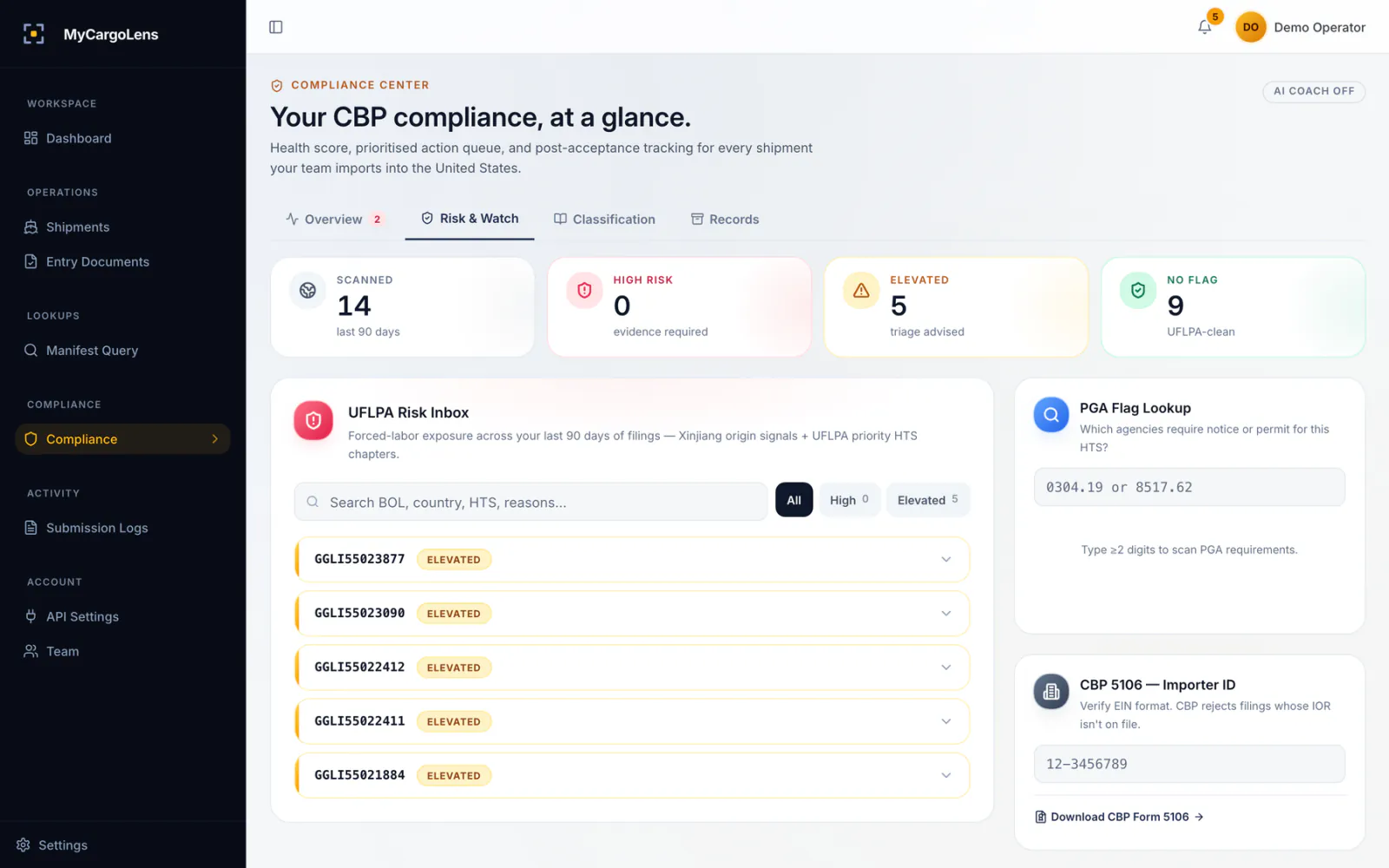
- Flags filings with possible UFLPA exposure, and shows which agencies (FDA, USDA-APHIS, EPA, FCC) may own an HTS code
- HTS code suggestions with alternatives and the reasoning behind them
- Duty calculator: rates, MPF/HMF and the total from HTS reference data
The inbox
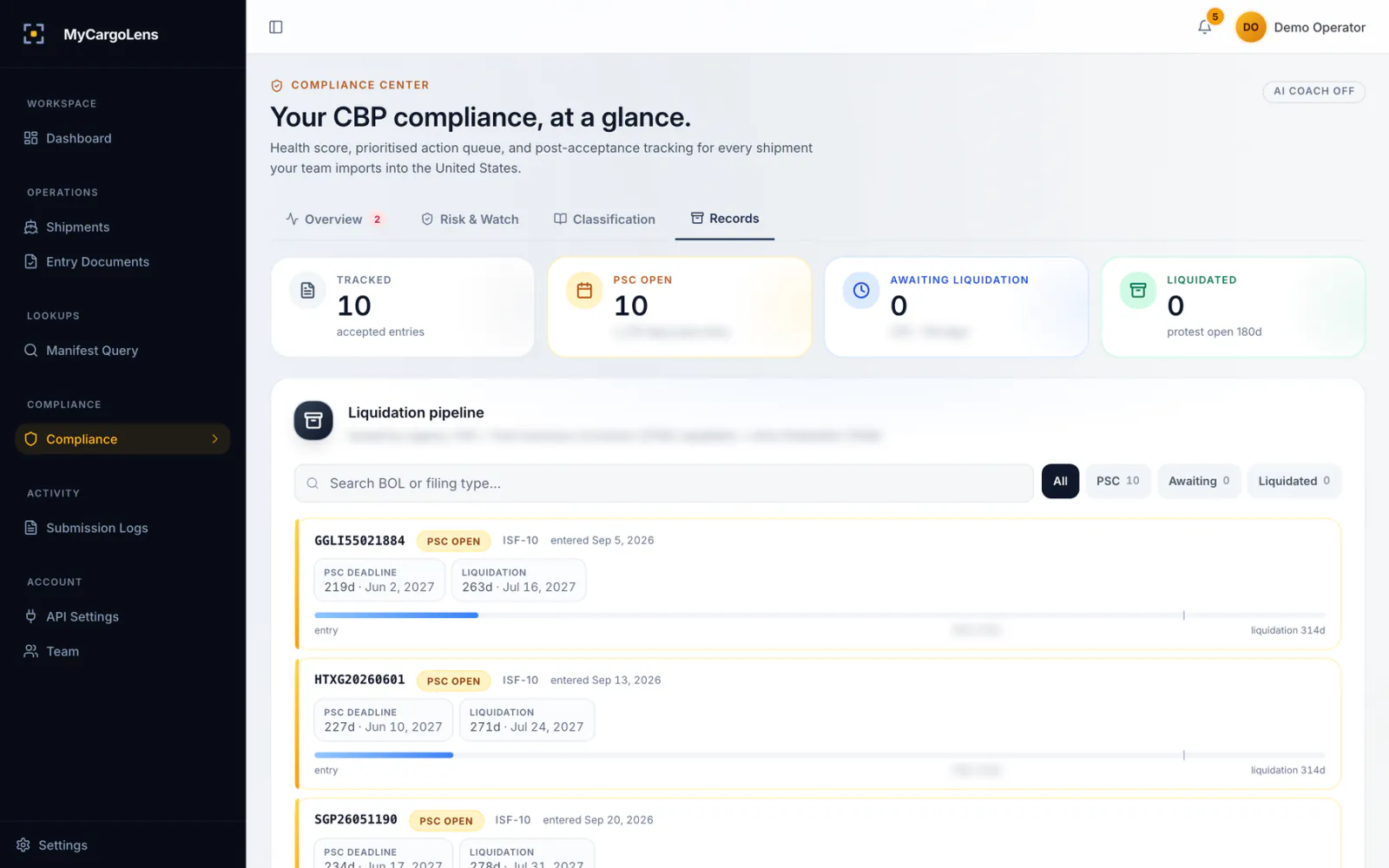
Every entry has a 314-day clock
Open work across ISF, entry and liquidation is ranked by urgency in one inbox. You start with the few filings that need you today.
- ISF deadline clock set 24 hours before lading, with alerts at 72, 48 and 24 hours before it
- CBP's response on each filing: accepted, rejected or still waiting
- Each accepted entry tracked through its 314-day liquidation window, with the post-summary correction deadline (300 days from entry, CBP's regular PSC window) in the inbox
- Container tracking with vessel ETAs and last free day, on request
Pricing
The ISF price is on the website
ISF Filing
$45 per accepted ISF
ISF-10 and ISF-5, templates, manifest query, deadline tracking
Customs entry
Talk to us
Entry summary (7501) and cargo release (3461), linked to the ISF. Container tracking and the duty calculator on request
Filing for others at volume
On request
NVOCCs, forwarders and brokers get volume pricing agreed in writing
- You're charged when CBP accepts the ISF. Rejected filings aren't charged
- Amendments aren't charged
- No monthly fee. Drafts and manifest queries are free
Customs entry is priced on a call. Tell us how many entries you file and we'll go through it with you in the demo, with the filing in your own hands either way.
Filing for others at volume? See volume pricing.
Your team sees the whole history.
Every edit, every submission and every CBP response stays on the filing with a name and a time. Four roles decide who can file and who can only look, MFA protects every sign-in, and the audit trail exports to CSV.
Who this is built for
A good fit
- Importers who ship every week or month and want their own team to see and check each ISF and entry.
- Teams that need several people with different roles in one account.
Probably not a fit yet
- One-off shipments, where a licensed broker or a DIY filing service will usually be simpler and cost less.
- Teams that need FTZ, drawback or AES in the same tool.
Questions importers ask
No. MyCargoLens is software for importers, forwarders, NVOCCs and customs brokers. You, or your broker, stay in charge of advice and classification decisions.
You might keep them. You can file your own ISFs and leave entries with the broker, or file both and keep the broker for advice. Either way, everything you file through MyCargoLens is checked before it goes and tracked through liquidation in one inbox.
Talk to us. Tell us on the demo how many entries you file and how you file them today, and we'll go through the price with you. The ISF price is on the website: $45, charged only when CBP accepts.
Self-filing has requirements of its own, and they depend on what you file. Ask us on the demo and we'll go through what you'd need on day one.
The importer of record stays responsible for its filings, whoever transmits them. That's why the deadline clock, the checks and the full record of every CBP request and response matter. We flag and explain; we don't promise to prevent penalties.
MyCargoLens does. Your team prepares and submits each filing, and we send it to CBP.
It suggests a code with alternatives and its reasoning. Your team or your broker makes the call. We don't publish an accuracy figure.
You get the error in plain English with numbered fix steps. Fix it and resubmit. Rejected filings aren't charged, and the resubmit is never charged twice.
Not for ISF filing. You pay $45 for each ISF that CBP accepts.
Book a demo
See your own kind of shipment in the inbox.
In 20 minutes we'll walk through how you file today, run a draft through the checks, and tell you what it would cost per shipment. Then we set your team up.
ISF is $45, charged only when CBP accepts. No monthly fee.