For NVOCCs and freight forwarders
Every house bill on a deadline clock.ISF filing software for NVOCCs and forwarders.
File ISF-10 and ISF-5 from your TMS through our API, or in bulk from templates. Each ISF gets a clock set 24 hours before lading, with alerts at 72, 48 and 24 hours before it.
We're taking a small number of paid NVOCC and forwarder pilots: API onboarding with our team, and volume pricing agreed in writing.

Why the ISF desk gets busy
One master bill. Several house bills. Several clocks.
The ISF is due 24 hours before the cargo is laden at the foreign port. On a consolidation each house bill is its own ISF, so each one carries its own liquidated-damages exposure. CBP's guideline amount is $5,000 per violation. Five late house bills on one consolidation is $25,000 of exposure.
And the shipper's data is often the last thing to arrive.
Sources: 19 CFR 149.2(b) (opens in a new tab) · CBP ISF FAQ 2.0 (May 2023) (opens in a new tab) · Great Lakes Customs Law (opens in a new tab). Figures are CBP's guideline amounts, not a prediction of any claim.
The inbox
Know which house bill needs you now
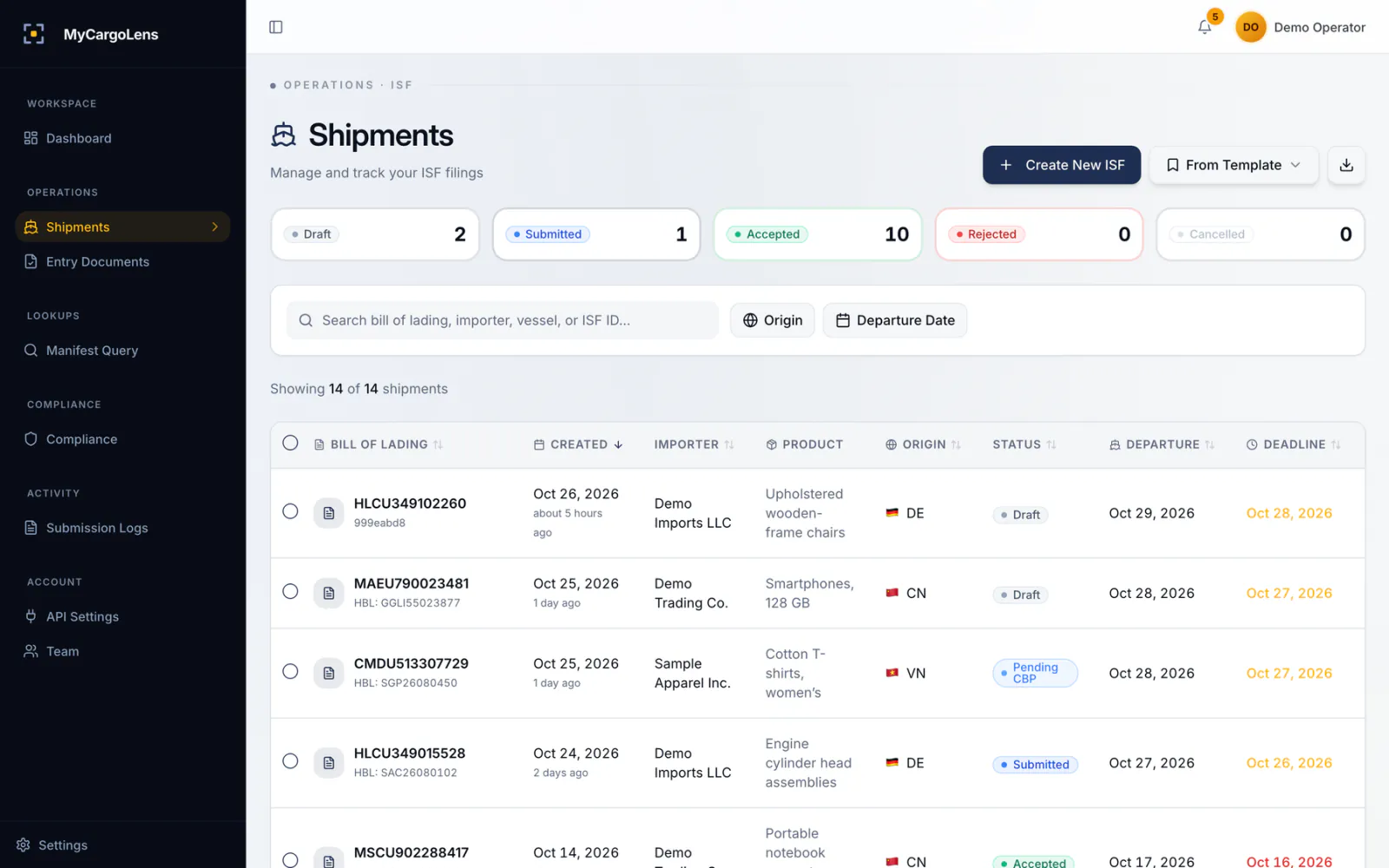
Open work is ranked by urgency in one inbox, so the ISF due tomorrow sits above the one due next week. House bills under one master stay linked, each with its own clock. See how ISF filing works.
- Deadline clock on every ISF, with alerts at 72, 48 and 24 hours before it
- CBP's response on every ISF: accepted, rejected or still waiting
- Manifest (MBOL) query by master bill shows CBP's disposition per house bill, so you can see whether the bill is on file. Queries are free
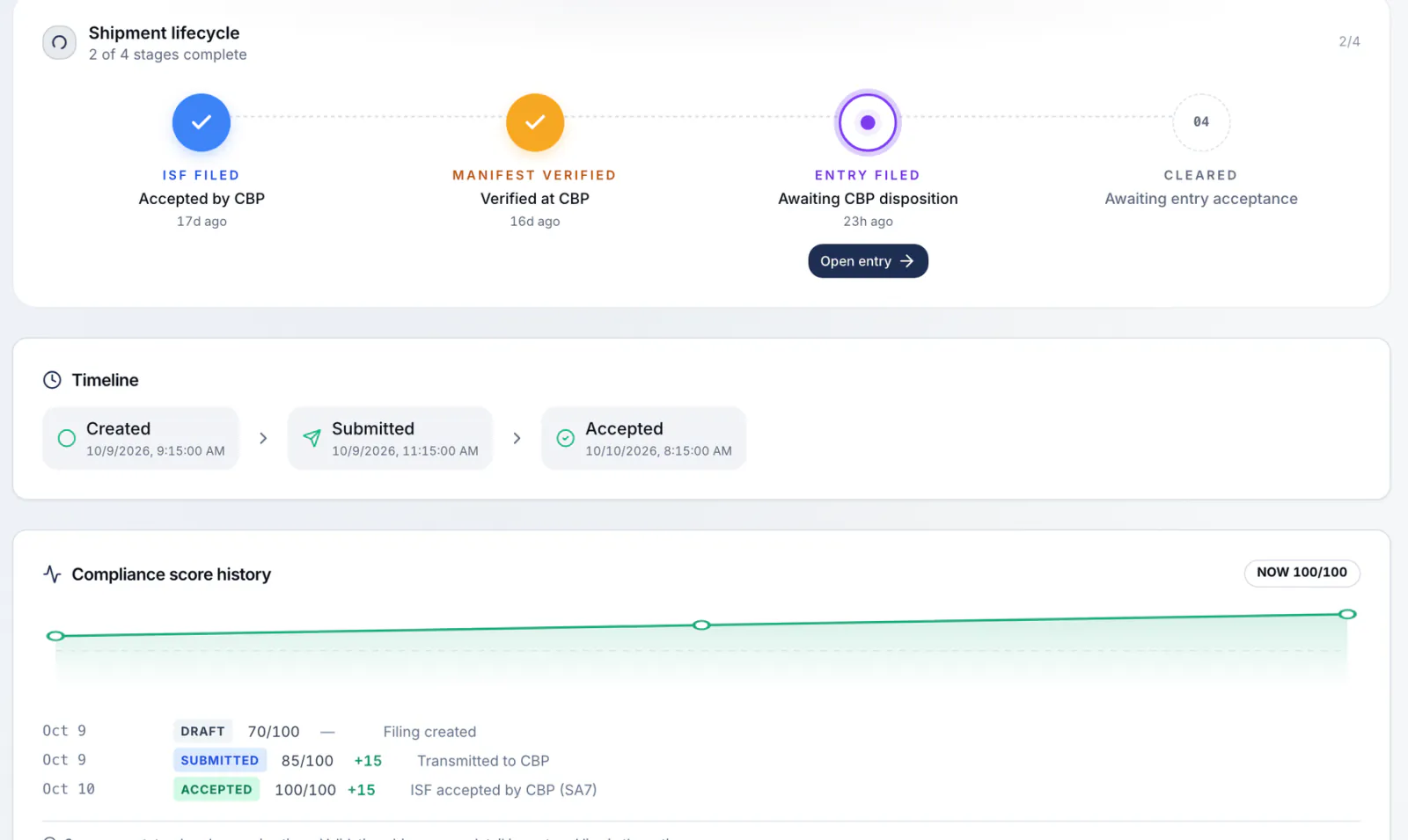
- Every filing's full history in one timeline, with a PDF export
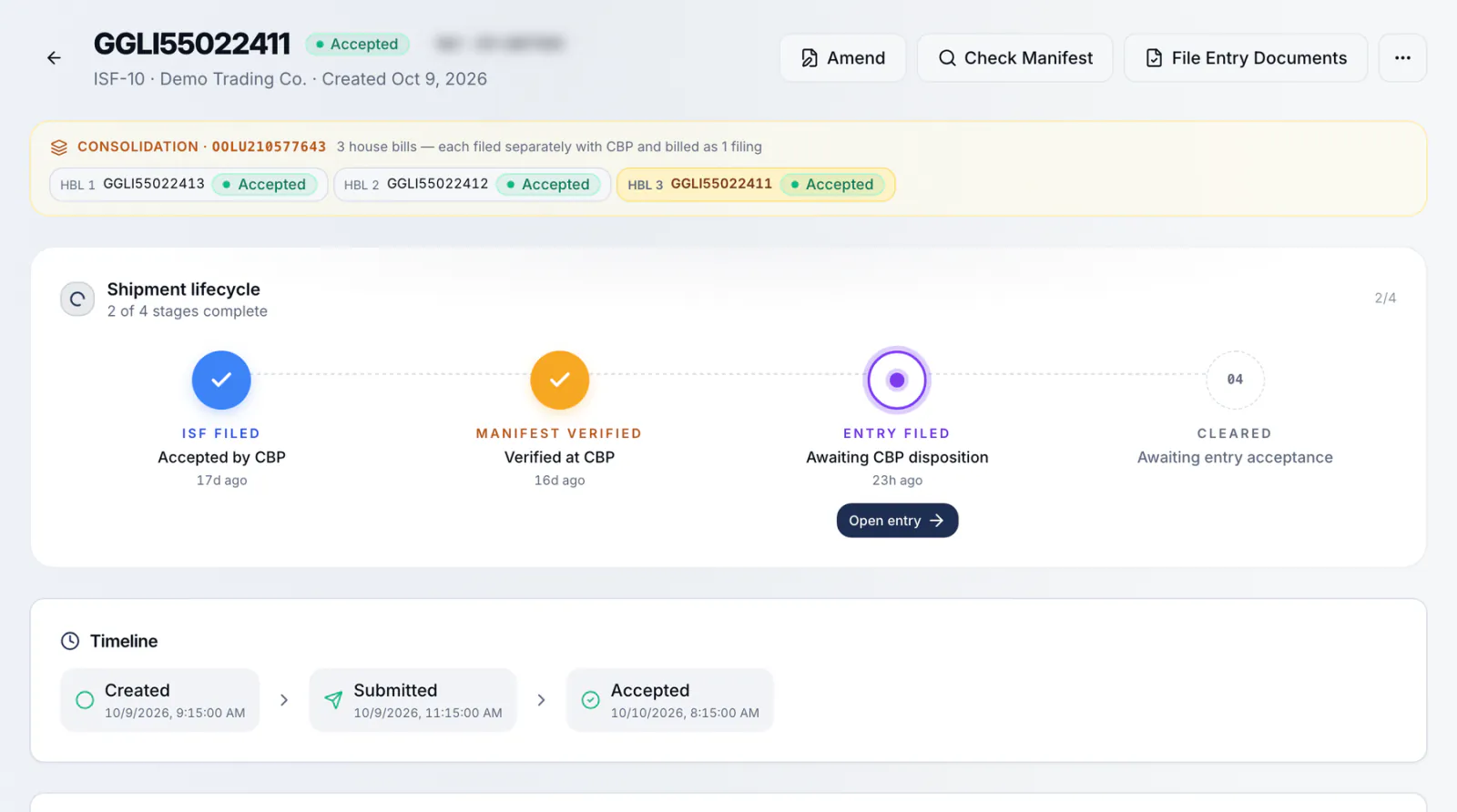
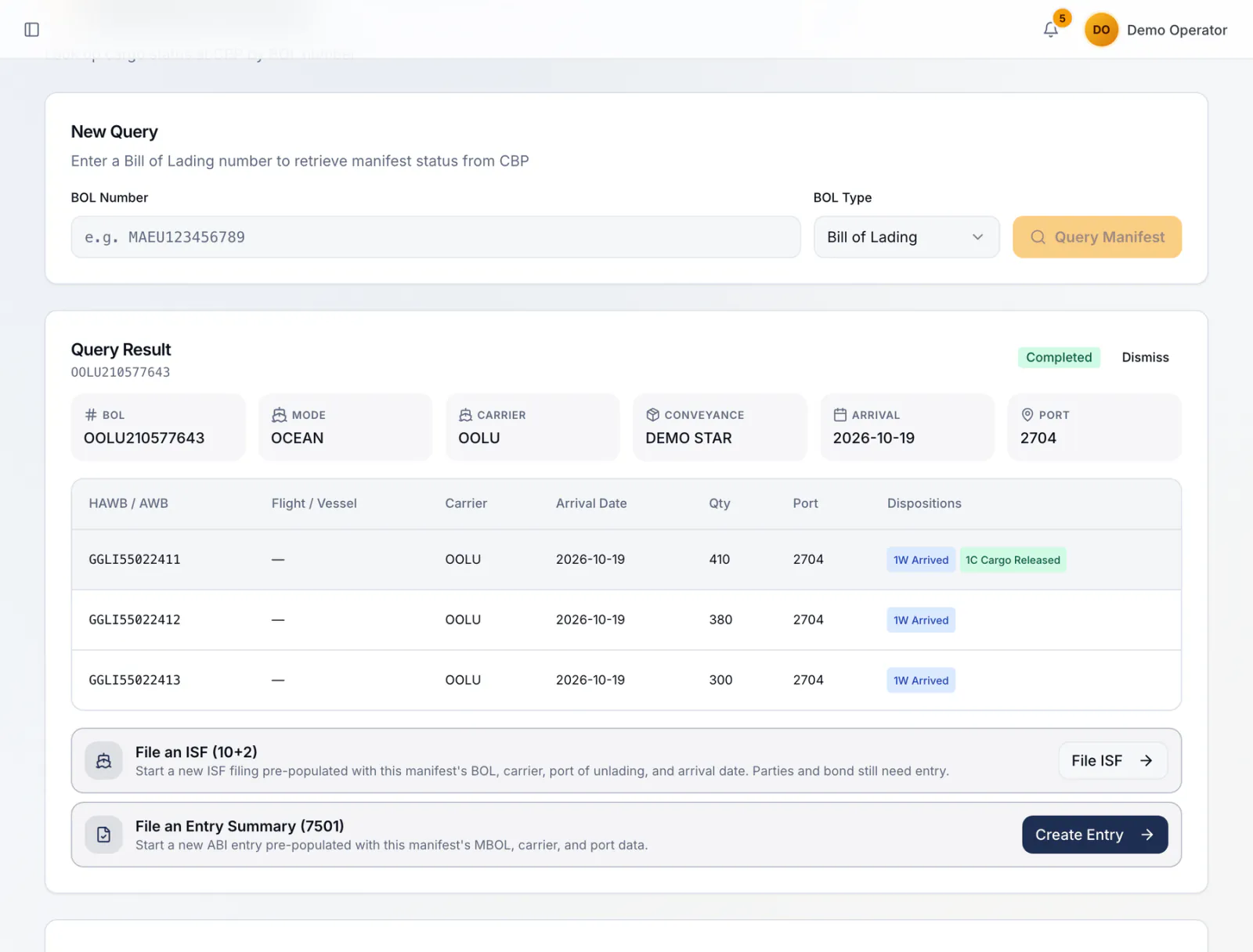
Consolidation OOLU210577643: three house bills, each its own ISF, and the manifest query per house bill. Sample data.
Two ways in
Start in the app. Add the API when you're ready.
You don't need a developer to start.
In the app: templates and bulk submit
- Save parties, ports, HTS lines and bond details as templates for repeat shippers
- Clone any filing
- Submit up to 20 drafts at once
- File ISF-10, and ISF-5 for FROB cargo
From your TMS: REST or XML API
/api/public/v1: create, submit and read ISFs and entries- JSON or XML, with scoped, revocable keys
- HMAC-SHA256-signed
filing.*andentry.*webhooks push status back to your system - The same checks and audit trail as the app
# 1. create an ISF draft from your TMS
POST /api/public/v1/shipments
Authorization: Bearer mcl_live_…

# 2. submit it (same checks as the app)
POST /api/public/v1/shipments/{id}/submit

# 3. status comes back, HMAC-SHA256 signed
webhook filing.accepted · filing.rejectedThe API is at version 1.0.0-foundation. There are no SDKs yet.
Audit trail
Show a customer exactly what was filed.
Every edit, submission and CBP response stays on the filing, so you can show what was sent, when and by whom. Your team works under four roles (Owner, Admin, Operator, Viewer) with MFA, and the audit trail exports to CSV.
Pricing
Volume pricing, written down
The per-shipment card on our pricing page is built for importers filing their own shipments. Teams filing ISFs at volume get volume pricing on request, agreed in writing.
We're taking a small number of paid NVOCC and forwarder pilots: API onboarding with our team, and volume pricing agreed in writing.
- You're charged when CBP accepts the shipment
- Rejected filings aren't charged, and resubmits and amendments are never charged twice
- Drafts and manifest queries are free
Tell us your monthly ISF count. We'll send the volume terms in writing.
What MyCargoLens files today
Files today
- ISF-10
- ISF-5 (FROB)
- Entry summary (7501)
- Cargo release (3461)
- Manifest (MBOL) query
Not available
- In-bond (7512)
- FTZ
- Drawback
- AES
- ISF bonds
If you need those in the same system every week, a broader suite may fit you better today. Tell us on the call and we'll say so.
What you can check before you sign
- The price principle
- Written on our website: you're charged only when CBP accepts.
- What we file
- ISF-10, ISF-5, 7501 and 3461, plus manifest queries.
- The record
- Every CBP request and response, logged and exportable.
Questions NVOCC teams ask
MyCargoLens does, whether your team submits in the app or your TMS submits through the API.
No. You can start with one lane or one customer's ISFs, run it next to what you have, and decide from there. Your existing system can keep everything else.
You wouldn't. $45 is the importer price on our website. NVOCCs and forwarders filing at volume get volume pricing on request, agreed in writing, with the same rule: charged only when CBP accepts.
No. You can file in the app from day one with templates, cloning and bulk submit of up to 20 drafts. When you're ready, your TMS can create and submit filings through the REST API in JSON or XML, and get signed status webhooks back.
Yes. MyCargoLens files ISF-10 and ISF-5.
Not today. We file ISF-10, ISF-5, entry summaries (7501) and cargo release (3461).
The error comes back in plain English with numbered fix steps. You fix it and resubmit, and the resubmit is never charged twice.
No. MyCargoLens is software. Your team stays the filer, and the importer of record stays responsible for the filing.
Book a demo
Bring a week of house bills.
In 20 minutes we'll show your kind of consolidations in the inbox, how your TMS could file through the API, and how our design-partner program works. Then we set your team up.
Volume and API pricing, written down.